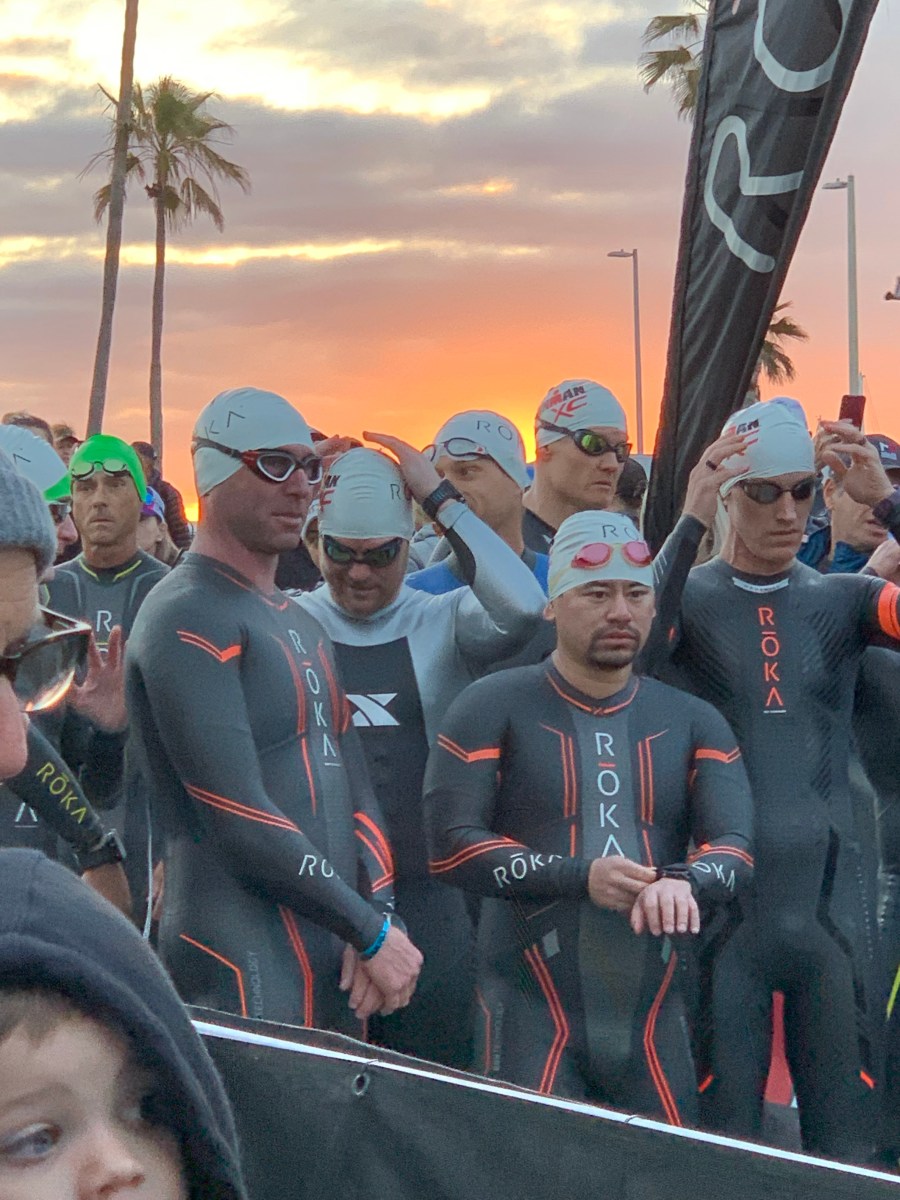
The organizers put the ocean back in Oceanside with a beach start — and a well-documented fear of open water meant I had no business on that start line. Here's how it went anyway.
As the title of this post suggests, the race organizers of Ironman 70.3 Oceanside did put the ocean back in Oceanside. How? By starting the swim from the beach as opposed to an in-water start in the harbor. If you know me, you know my well documented fear of open water swimming, and you must be wondering how the heck I ended up on the start line of such an early season race that starts in the Pacific Ocean. Well, for that I have my good friends Isaac and Maria Keselman to blame.
Abby and I were invited to hang out in the beach house last summer, so we did. When we arrived, Maria handed me a bottle of Poland Spring. Or so I thought. It turned out you can't drink alcohol on the beach so Maria kindly replaced the water with vodka. A couple of bottles later, Isaac and I were bobbing up and down in the Atlantic and he asked if I wanted to do Oceanside. The vodka said yes.
I signed up a couple of months later and now here I was in Oceanside, California getting ready to do my first outdoor swim since Ironman Lake Placid 9 months prior (which reminds me… I need to write that race report).
 View of the swim course from our Airbnb
We arrived to the race venue on Thursday afternoon. We flew from Newark to San Diego, and Meb Keflezighi happened to be on our flight. We had met Meb a few times prior (thanks to United sponsoring the NYC Marathon), so we sort of knew each other. He was a super nice guy, and even stopped by my seat mid-flight to chat. He asked what I was doing in San Diego, and I told him about the race. He wished me luck, which I think was a harbinger of how I was going to run later (thanks, Meb!).
 Abby, me, Meb
After we settled into our Airbnb, I went to get my bike from Isaac's hotel room, since XC was kind enough to pick up my bike and gear bag from TriBike Transport for me. I had not planned on riding that day, since my coach just put a 20 minute run on my schedule. However, since Isaac and another XC athlete (Mike) were riding, I decided to join them. This may or may not have been the greatest decision because of what happened later.
We rode from the hotel to The Strand and down part of the run course. At one point we turned towards the far turnaround of the run course, which is where Mike dropped his chain. Somehow he managed to get his chain really wedged in between the small chainring and his frame, and neither Isaac, Mike, nor I could get it free without damaging the frame. We were only about a mile or so from the expo, so Mike decided to walk it while Isaac and I rode on for a few more minutes. On our way back, we passed Mike and I slowed down to see if he was OK. He said he was, so I started to ride again. Almost immediately as I stood to pedal, a water bottle I had placed in my rear bottle holder flew out and got wedged between my rear wheel and frame. I was clipped in when this happened, and one second I was pedaling, and the next my rear wheel had completely locked and I could not pedal at all. Since I was not going very fast I started to fall over. Luckily I was able to maintain my balance, not panic, quickly unclip and stand up to avoid a pre-race crash. Mike saw the whole thing happen, and he was shocked I didn't crash.
I pulled the water bottle out of where it was stuck and handed it to Mike. My bike looked fine, so I mounted and started to ride. Within a quarter of a pedal stroke my crank hit something and wouldn't move forward. I had to quickly unclip and dismount again, and I noticed that the crank was hitting the front derailleur. Apparently the water bottle had caused the front derailleur to shift and my crank no longer had clearance past it. Without any tools with me, I had to walk the remaining distance to the expo and hand my bike to the mechanics.
Now you may be wondering what all of this has to do with the race. Trust me, all of this will make sense later, and this is all relevant.
After we got back to the hotel, Abby picked me up and we went on my 20 minute run. We decided to run around the swim course to check it out. The water was pretty calm at that time, and they were expecting just 2–4 foot waves, so they anticipated it to be a beach start as planned. I wanted to practice getting into the water, but unfortunately we were out of time with the bike snafu.
 Abby and I at swim start (forgive my hair)
The XC Welcome Dinner is pretty fun. We get to see the other XC athletes and their families, and since 80+% of XC athletes return for the races, we get to know each other fairly well. It's also at the Welcome Dinner where we get to register and forego having to go to regular Athlete Check-In. It's a pretty cool perk of XC: registration comes to you.
The next day, we had to check in our bikes since the race was on Saturday. Before that, we had our traditional XC breakfast where we met Joe Gambles (also Heather Jackson's coach). Joe is a pretty cool guy, and gave us lots of advice on the course having raced it about half a dozen times prior. He could not give us any direct advice on the beach start since this was the first time they were doing it at this race, but he did give us general beach start advice, which was essentially to not fight the waves. He advised us to look for the wave to come in, and before it hits, dive under and grab the sand to hang on. Allow the wave to roll over you, and then go back up to the surface. This seemed like pretty good advice, but it was much harder in practice.
After the breakfast, the XC guys took us to swim start to get into the water. At that time, the water was pretty rough with 4–6 foot waves but it was good to practice since the waves were forecasted to be calmer on race morning.
One thing that's really awesome about the XC family is that it truly is that: family. The entire time I was in the water, Mike Cummings (who I just met the day before) and Isaac stayed with me the entire time. They both kept me calm and made sure I was OK. An experienced boater, Mike also gave me a ton of advice and pointers in how to deal with the waves. He even had me practice ducking under the waves and told me what I was doing right and wrong. We spent about 20 minutes out there in 60.2 degree water, and I couldn't be more grateful for their help.
After the swim we all rode down together to bike check in. During this short ride I made sure my bike was fully functioning, and she was. She was shifting like a dream and handling really well. I had no issues at all with her.
Or so I thought. After racking my bike, one of my XC teammates noticed something on my rear tire. He took a closer look and realized that the tire in that spot was completely bald. You could see the air being held in place by the thinnest layer of cotton. This must have happened because of the water bottle the day before (see? I told you that story was relevant). What was strange was that I could not feel it while I rode, and the mechanic who worked on my bike did not notice that massive hole.
 Look at that!
Had my teammate not noticed, I probably would have lasted no more than 5 miles before an irreparable flat. Lucky for me, he did — and even luckier, I had Isaac and the XC team to help take care of me. As soon as people realized what happened, the XC team drove me and my bike back to their hotel so Isaac could give me his spare race wheel. Since the race wheels I brought were tubulars, there was no way to get one glued and cured in time (that takes about 24 hours). Luckily, Isaac travels with a spare set of race wheels.
After swapping out my rear wheel (luckily Shimano cassettes and SRAM groupsets are interchangeable), I rode to transition while the XC guys followed me in their van. On the ride there, I tested everything, and once again everything was working perfectly. Once I re-racked my bike, Frankie and Troy drove me back to my apartment. XC is the best.
Now on to the race.
The Swim
The swim course for Oceanside changed to incorporate a beach start. Athletes start on the beach, run into the water, and swim to a turn buoy a few hundred meters off shore. Upon reaching it, athletes swim between two jetties and then turn right into the mouth of the harbor — about 4/10ths of a mile. Once in the harbor, there's a slight current that brings you to the next right turn, then a straight shot down the harbor to the final 90 degree turn before the boat ramp swim exit.
It seemed simple enough, but I would later find out that the swim into the harbor goes directly east. This meant the sun would be rising directly over the coast, leaving me unable to see where I was going during that entire stretch. The race director had warned us during lunch the previous day, but for some reason the significance didn't register, so I didn't prepare properly. I only brought my Roka R1 Cobalt and Vermilion goggles, neither of which are tinted enough to protect against direct sunlight. D'oh.
The XC group was slated to start at 6:46, six minutes behind the pro women. There was a lot of confusion, however: after the pro women started, one official told us to go while another told us to wait. They argued back and forth while we stood there confused.
This turned out to be a blessing in disguise, because the confusion kept me from focusing on what was in front of me. The entire time I was in the corral, I did not look at the water. I chatted with my XC friends about anything but the race. I am really glad I didn't look, because I saw the photo afterward — those waves were not 2–4 feet. Had I noticed them, I think I would have been too nervous to get in.
The officials decided to let us go early and we went in right after the pro women. While most of my XC friends ran full tilt into the water, I slowly jogged my way in. I did not want to get my heart rate up before I even got into the water, so I took my time. When I thought I was deep enough, I did a shallow dive in. It turned out I wasn't deep enough yet — my first stroke hit the sand beneath me — so I got back up and kept wading in.
Eventually I was able to start to swim, which I tried to do with a relaxed stroke. I tend to have a very high stroke rate, and Isaac and my coach keep telling me to slow it down. Unfortunately what always happens for me in open water is that my stroke goes to shit. I'm not a fast swimmer in the pool by far, but my stroke is 100x better in the pool than in open water. I ended up swimming all over the place. I had so much trouble sighting too, since I was struggling with the waves: one second I could see my teammates ahead of me, the next there was nothing in front of me except open ocean.
The turn buoy was a couple hundred meters ahead, but I could not seem to get there, nor keep it in sight. I looked back at the shore a couple of times, debating whether to turn around. Thoughts of quitting started to creep in. But I did not want to. I had a good open water year behind me, and I knew I could do this swim. I thought about all the support people had given me — Isaac, Trevor, Abby, Jimmy and Diaa of Ventum, my new XC friend Mike, and many others — and I tried to draw strength from them. Plus I trained for this race more consistently than I ever had. Since January, the only days off were the seven where I was sick. I knew I had the training to get through it.
It took me seventeen minutes to reach that first buoy.
Once I made the turn, the other age group waves caught up to me. I used the people passing me to help sight off of — I know you're not supposed to, but I really did not want to end up swimming to Kona. As I made the next turn, the sun shone directly into our eyes and I could see nothing at all, stopping several times to make sure I was still headed the right way. Eventually I made the final turn buoy and started to swim home.
Once I got to the ramp, I checked my time and saw I had safely made the cut-off. It was not my worst swim by any stretch, but it certainly was my toughest. I struggled badly with the waves and felt out of breath almost immediately. I wanted to quit so badly, but somehow I got through it. At that point I was physically and mentally exhausted.
Swim Time: 50:25
T1
After exiting the water via the boat ramp, you run around transition before entering at the bottom end. I ran to my bike and saw Abby, Maria, Frankie, and Troy right there. Since it was a 70.3 with a half marathon at the end, I went to put socks on — my thinking is that if I "lose" time putting socks on, I may as well do it when I have the most real estate to make up the time.
For some reason, I had a really hard time getting them on properly, and had to take them back off because I'd put them on backwards. Then my bike was firmly stuck on the rack. Nothing I tried helped, and at one point I lifted the entire rack by my bike. Poor Frankie was next to me trying to figure out what to do without getting me disqualified. Finally I got it free and off I went. All said and done, it took me way too long. A quick transition is something I'm usually proud of — but not this time.
T1 Time: 5:40
Bike
This bike course turned out a lot harder than I thought. I knew it has ~2,700 feet of climbing, but I have done harder courses, so I did not think it would be that bad. It was — partly because I had nothing in my legs that day, but also because of how the climbs are structured. Oceanside has climbs throughout, with three major ones, and the course can be relentless with hills and a headwind for the last 16 miles.
As soon as I got on the first small climb out of town, I knew my legs were in trouble. They had no freshness or "pop," and I worked far harder than I should have on a small hill. I also realized my front wheel was rubbing — that scritching noise of the carbon track against the brake. I pulled over on the highway to adjust it, but no matter what I did, it kept rubbing. Sadly I can't blame my ride on it. I just had zero legs and could not generate any power. My Normalized Power was low zone 2, fully 30 watts under target.
 I felt about as good as I looked.
By the time the first aid station rolled around I again thought about quitting. This was only a 56 mile ride, but I honestly had doubts I could finish. As I approached Hell Hill around mile 28, I could see how bad it looked from a mile away. Thinking hills always look worse than they are, I figured it would get better as I got closer. Nope. Hell Hill is short (~0.75 miles) but immediately kicks up to roughly an 11% grade. Eventually I made it to the top, not without some curse words between gasps.
One good thing about going so slowly was that I received a lot of compliments on my custom Wyn Republic kit. I gave people plenty of time to appreciate it as they passed me.
To make climbing harder, I couldn't shift from my small chainring to my large one — the derailleur would move but the chain wouldn't. To shift up I had to get off the bike and manually move the chain. After a while I gave up and just stayed in the large ring, which destroyed my legs for the run. All in all, a very tough day on the bike.
Bike Time: 3:38:05 (I might as well have been on a Citibike.)
T2
Once I dismounted, I reached my rack and sat down to fix a sock that was bothering me. Since I knew my time was already terrible, I decided not to rush. After changing into my running shoes and grabbing my hat and sunglasses, I stopped by the XC port-a-potty, grabbed a cup of water from a volunteer, and started the run.
T2 Time: 3:37
Run
The run is a fairly flat two loop course. As I came out of T2, I honestly had no idea how my legs would respond. I historically never run well off the bike, and after the horrible ride I'd had, I thought I'd be in for the worst run of my life. I actually planned to make it to mile 1, where Abby and the others were, and call it a day.
Surprisingly, my legs felt OK. When I saw Isaac heading to the turnaround and told him I felt like shit (I did), he yelled at me to keep running. So I did.
I took the first of three Maurten gels at the first water station. On the steep ramp up to the Oceanside Pier, people around me immediately started walking, but I kept running and controlled my effort — on my toes, running light, HR hovering around 160. On the steep downhills I slowed way down, leaned slightly back, and made sure my foot struck directly underneath me to save my quads.
One thing that annoyed me — and actually fueled me through the second loop — was that the mile markers did not match my watch at all, each one 0.4 to 0.6 miles off. It wreaked havoc on my finish-time math (which I can't do on a good day). For the rest of the loop I just focused on three things: heart rate, effort, and relaxation.
In the last 3 miles I started to fade, so from mile 10 I switched from water to Red Bull and Coke at the aid stations and took my last gel as I got hungry. I started thinking about the In-N-Out double-double and cheese fries waiting afterward.
Finally I hit the finish chute. Like all finish chutes, I was completely spent — I just kept running as hard as I could until I crossed the line and Abby gave me my medal.
Run Time: 1:57:24 (which was actually a 1:41 PR from Ironman 70.3 Mont-Tremblant in 2015)
Overall Time: 6:35:09 (ouch)
Closing Thoughts
Admittedly I was initially bitterly disappointed. Once I reached the VIP tent, I cried. I was not happy with how much I struggled on the swim after great open water swims the year before, and I was not happy with my bike. I'd worked so hard to get to the start line in a position to have a solid day.
Now, some time later, I'm in a much better place about it. Everyone was kind and quick to remind me of the important part: I got through the swim. Trevor and Isaac came over after and said they thought about me during the swim — that it was one of the roughest they'd had, and they were worried about me. The fact that these guys thought about me during their own race is remarkable, and made me feel all the feels.
Triathlon is such a tough sport. You have to train your body and mind for three very different disciplines, and then handle everything each leg throws at you. Something will almost always go wrong, and you have to accept it, adapt, and keep fighting toward your goal. That's what I have to focus on now: I had a tough swim and a shitty day on the bike, but I adapted and continued to fight. I'm a stronger athlete, physically and mentally, for it.
Now onto WTS Bermuda and beyond.