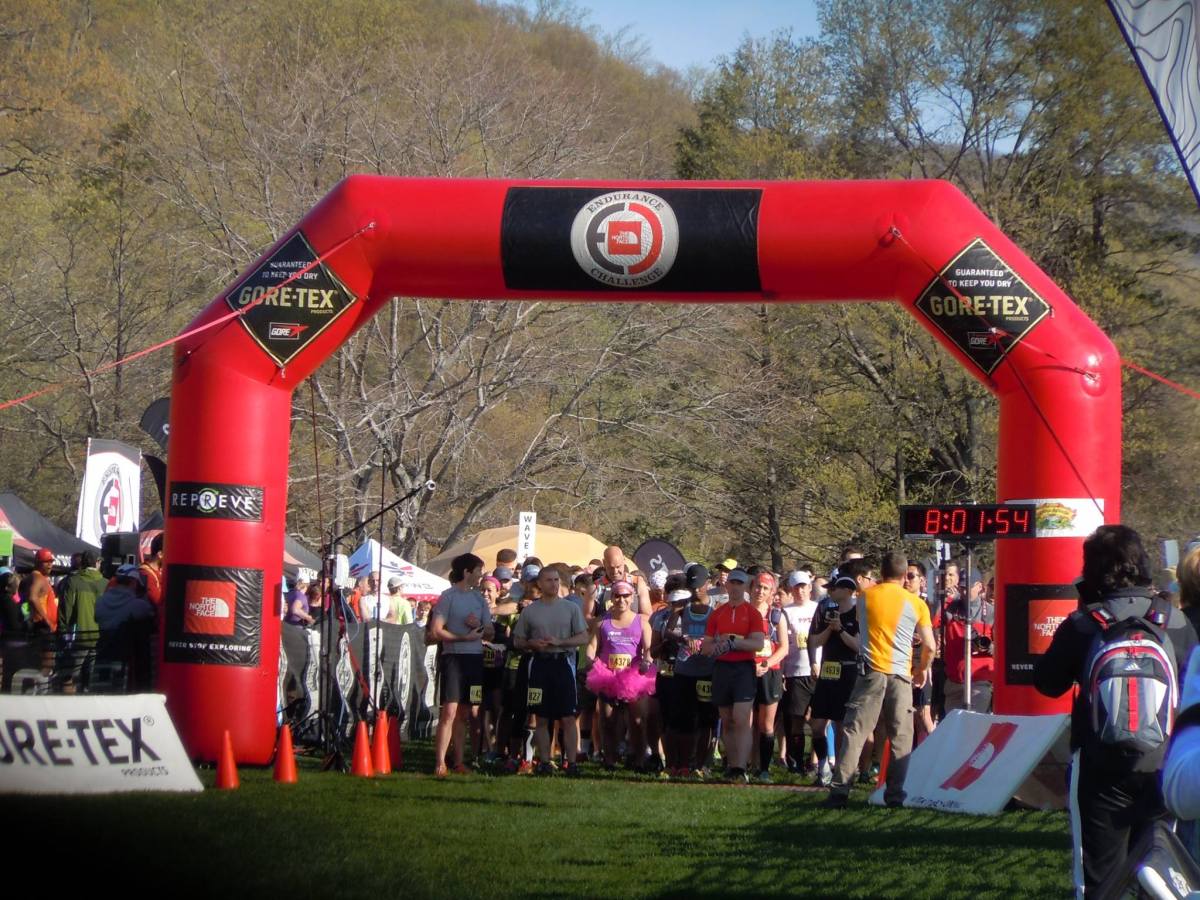
The North Face Bear Mountain half — a brutal trail race I went into ambivalent and came out of having relearned two things: that a bad training block isn't who you are, and that I could push through pain again.
Now that I'm on a flight to ORD, I've finally had a chance to reflect on today's race. I went into Bear feeling pretty ambivalent about racing — and came out quite pleased with the result.
When I woke up I was not excited to race. None of the usual anticipation, mostly because April had been a brutal (read: shitty) training block — exhausted early in the month, a total nutrition overhaul, some spectacular failures in training and racing. I won't even get into the Hook Mountain Half two weeks ago, except to say it was a massive disaster. So I stumbled out of bed, ate, put on my race outfit (the pink tutu came later), and drove to the start with Alysen, not feeling it.
Once we started, the congestion in the first mile or two let me take it easy and relax into it. I noticed runners around me already breathing incredibly hard, so I stayed with the pack, in control, in case I was missing something — like the fact that we were running uphill, over rocks. That turned out to be exactly the right move. When we hit Anthony Wayne and got onto actual ROADS, I was so happy I picked it up to 7:15–7:30 pace — until I remembered that was mile 4.5 of a 13.6-mile race up a mountain. I eased back into an easy long-run pace and got back into the trails.
My coach for this one was Michael Bielik — who'd finished a 50-miler the day before and decided to jump into the half. He's crazy. His plan: power-walk the major uphills, attack the downhills and flats. It led to some "tag" games — I'd pass people on the downhills (sometimes making my own trail) and they'd catch me on the climbs — but I knew they were spending far more energy than I was. After Timp Pass (a ~25% grade around mile 9 that wrecked everyone), I finally dropped most of them.
At mile 10 I realized I had a real shot at my goal time — if I ignored the pain in my ankle, quads, and calves and just went. After some internal back-and-forth I said "f*** it" and took off. It worked until two hills I'd completely forgotten appeared in the last 2.5 miles. I'd be flying sub-8, turn a corner, and hit a wall of non-runnable rock. More than one racer heard me yell, "Where the f*** did this come from?!" I negotiated with my legs — run for me over this crest and it's the last hill you'll see — and lied to them repeatedly. I'm certain they'll collect tomorrow.
In the finishing chute, my left calf cramp from mile 11 fully announced itself. Not wanting to keel over in front of my teammates and coaches (think of the paperwork TNT would have to file), I just focused on crossing — which cost me my one regret of the day: no patented "John Tan Finish Line Jump Cross." Oh well. Other races.
Bear taught me two things.
First, the advice I'd given other TNT athletes and forgotten myself: it's OK to be upset about a bad training session, but a bad session can deliver more mental gain than the physical gain you think you lost. Getting through it teaches you how to handle adversity on race day. Understand why you failed, learn from it, move on. We're not the result of one or two bad sessions — we're the accumulation of the work we've put in over seasons and years. Put in the effort and you'll be fine.
Second, pushing through the suffering. Since coming back from injury in January, and after how much I suffered at 70.3 Mont-Tremblant last June, I'd become afraid of pain — afraid to push in training and races like I used to, afraid of re-injury, afraid I couldn't. I lost faith in myself and forgot what it means to really challenge yourself. Bear reminded me I still have it. When I wanted to stop on Timp Pass and rest, I refused and kept climbing — partly from fear that gravity would tip me onto the runners below, but mostly because I knew I could keep going and didn't need to stop. That knowledge is what I'd been missing, and Bear gave it back.
This doesn't mean everything's fixed, or that I'll be clocking sub-7s with ease again. I'll keep having challenges and bad sessions — but now I'm better equipped to handle them. Six weeks until my main race for the season: time to reset mentally, dial in nutrition, and work as hard as I can.
After all, the best way to prepare for a race is to approach it with confidence. (And an awesome finisher pic.)