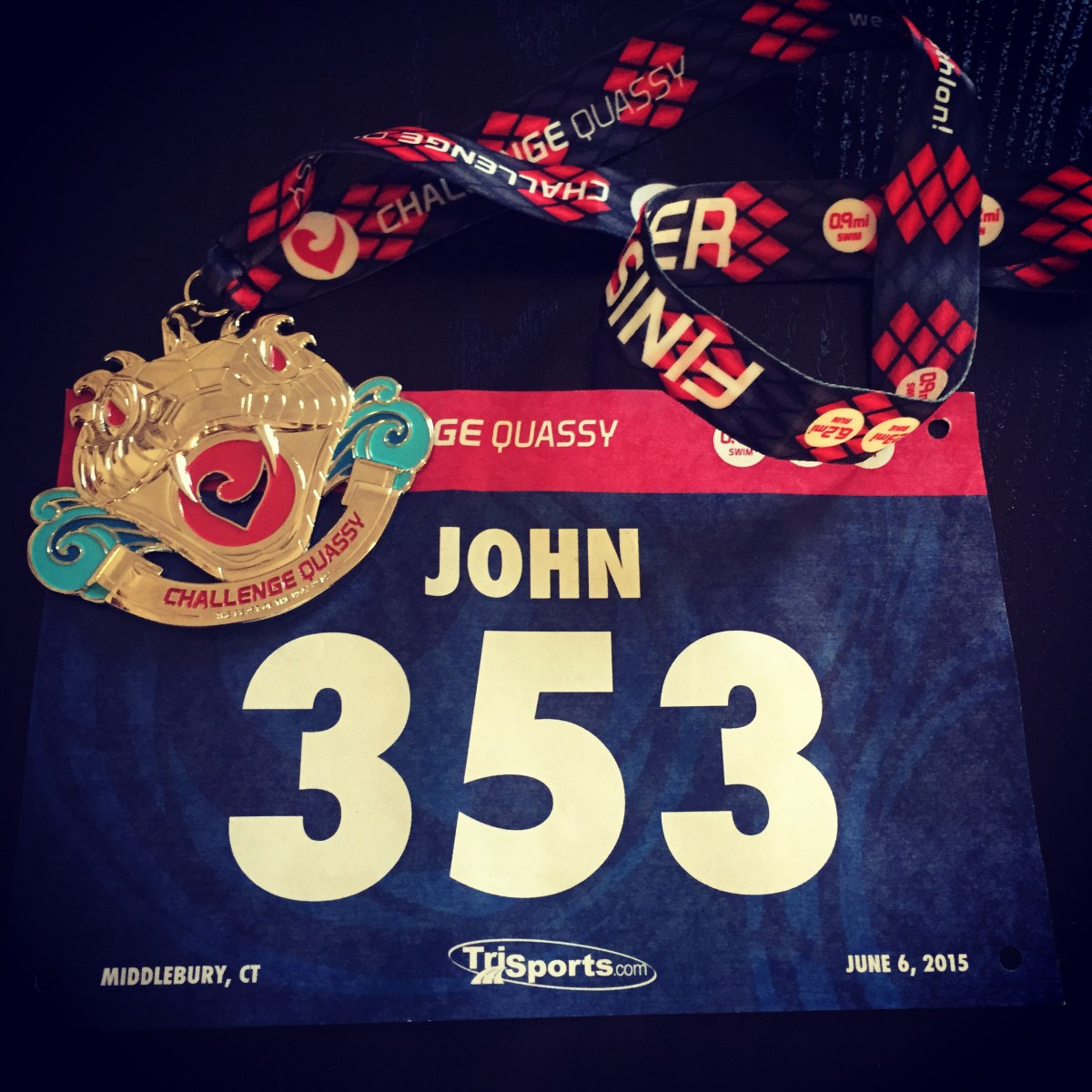
Challenge (née Rev3) Quassy in one word: relentless. A brutally honest course, one of the best swims of my life, an almost-pro transition — and a hamstring that had other plans.
If I could describe the Challenge (née Rev3) Quassy course in a word, I'd use relentless. Or "unforgiving." It's a brutally honest course that tests every pedal stroke and every step — 1,864 feet of climbing on the Olympic bike, 464 on the run, with the only flat sections being transition. Triathlon Magazine called the Half the toughest half bike course they'd ridden.
The Swim
The swim is in Lake Quassapaug (try spelling that without spell check) — calm, semi-clear, triangular course. I felt some anxiety on race morning, but less than usual, which I took as a good sign. When the gun went off I walked in, found clear space, and started swimming smooth and easy. And then something new happened: I was swimming with people. Normally I get left behind immediately; this time I stayed with the pack through the first buoy — competitive for the first 0.1 mile of an Olympic, woohoo, progress! With only 600 athletes I had room to sight off people and buoys and just stay calm. I made the first turn without anxiety or an elevated heart rate and realized I might get through the whole swim without stopping for a kayak. I did, and came out in 36:09 — 5:22 faster than last year.
Swim: 36:09
T1
So happy I sprinted the hill to transition, got disoriented (I'd been trying to rotate more in the water per my coach), and ran sideways into two other athletes. Apologized, found my bike, fought the wetsuit. 1:20.
Bike
Onto the course — and immediately I noticed my Garmin was sideways in the mount and getting no power data. (I'd also forgotten my heart-rate sensor. Test your gear, folks.) So, no metrics. I'd decided to ride the hills hard and see what happened on the run — so I hammered. And then I cramped, hard: a side stitch around halfway that forced me out of aero until I could shake it.
This course is relentlessly hilly — and technical, with turns right before or after climbs that kill your momentum. There were a few epic descents, though: I hit 48.21 mph on one, close to my personal record (52 in Syracuse). Two notes: I actually passed a teammate on the bike for the first time ever (my teammates win their age groups; I show up to races), and on a rough patch my saddle went straight into my nuts because I didn't lift high enough. Hashtag oops.
Bike: 1:31:11
T2: :48 — almost pro-style. WOOHOO.
Run
The first quarter mile felt great until I looked down: 6:30 pace, way too fast even downhill. I settled into a 7:49 opening mile, then the hills I'd hammered on the bike started collecting their debt. I locked onto a woman ahead and tried to reel her in. Mile 2 was the first really major hill — it took everything not to walk it.
Then, cresting toward the biggest climb of the day, my plan was to let it rip on the downhill and catch her. Instead my left hamstring seized with zero warning — one second I was lengthening my stride, the next I was hopping downhill on one leg. A triathlete passing me said, "Leg cramp? Here," and handed me two pills. In a blur of pain and sweat I said "thanks" and took them, no idea what they were. (Kids, don't take candy from strangers. Unless you're an adult trying to finish a race.) A police officer drove up and offered me a ride home; I said, "Thanks, but hell no." He said, "Figured as much — keep going, buddy."
The rest was a limp/walk/jog as my left hamstring and right quad traded off seizing. Friends starting their run and the TriLife and Tailwind coaches offered encouragement as I hobbled past. (One volunteer near mile 1 told me, "Great job, you're almost there!" Mile. One. My near-automatic reply was unprintable; I managed to just ignore her. Who says that at mile 1?) At the finish chute the announcer called it: "Oh man, he's got a wicked cramp but is still going — you've got this, John!" Steps from the line, he was correct that I was almost there.
Run: 55:07 / Total: 3:04:35
I never caught the woman, and the run was a mess — but I'm positive about this one. My transitions were on point and I had one of the best swims of my life. It's still slow compared to everyone else, but I don't really care about everyone else. I'm a work in progress, and I'll keep chipping away at this open-water fear. Hopefully by this time next year I'll be free of it and training for my next Ironman.
Until then — 70.3 Mont-Tremblant in two weeks.